
Where is the price of electricity heading?
How the electricity market has changed since the energy crisis
During the energy crisis, electricity prices became a topic of discussion in almost every Finnish household, and many people started following electricity prices on a daily basis. Since then, the market has changed significantly.
The average wholesale electricity price in Finland fell from around €166 per megawatt-hour in 2022 to €57 in 2023, €46 in 2024 and approximately €40 in 2025. In other words, the average price in 2025 was around one quarter of the 2022 level. (Source: Finnish Energy)
However, 2026 has served as a reminder of one of the key characteristics of the electricity market: prices do not move steadily in one direction.
Electricity is cheaper than during the crisis, but prices still fluctuate
Prices have fallen clearly from the exceptional levels seen during the energy crisis. However, this does not mean that electricity prices will fall every year or that there will no longer be periods of high prices.
In Finland, the average spot price of electricity (area price) from January to June 2026 was €70.8 per megawatt-hour (€/MWh). For consumers, this corresponds to approximately 7.08 cents per kilowatt-hour (c/kWh) before tax. During the same period in 2025, the average price was €38.6 per megawatt-hour. Prices in the first half of 2026 were pushed up by factors including cold weather and increased electricity consumption.
This is a good example of why electricity prices should be viewed over a longer period. One expensive month does not mean a return to energy-crisis price levels. Likewise, one exceptionally cheap month does not mean that electricity will always be cheap in the future.
What affects electricity prices in Finland?
Spot electricity prices are determined by supply and demand. In practice, many factors affect the price at the same time: weather and especially temperature, electricity consumption, wind and solar power generation, the availability of nuclear and hydropower, transmission connections between Finland and neighbouring countries, the situation in electricity markets elsewhere in Europe, as well as ongoing crises and wars around the world.
For example, electricity consumption can rise rapidly on a cold winter day. In January 2026, Finland set a new all-time electricity consumption record, with demand briefly reaching 15,553 megawatts. At the same time, Finland’s electricity production also reached a new winter record. (Source: Fingrid)
The electricity market was therefore able to meet record-high demand without prices rising to the levels seen during the energy crisis.
More electricity generation is continuously being built in Finland
One of the biggest changes in the Finnish electricity market is the rapid growth of new generation capacity.
During the first half of 2026 alone, 510 megawatts of new renewable electricity generation capacity was connected to Finland’s electricity system. Of this, 108 megawatts came from wind power and 402 megawatts from solar power. (Fingrid)
Increasing generation capacity means there will be more periods when electricity is widely available and market prices are low. At the same time, renewable electricity generation varies depending on weather conditions. This means that the electricity market of the future may see both extremely cheap periods and, at times, very expensive ones.
Price fluctuations are therefore not an exception. They are becoming an increasingly common part of the electricity market.
Electricity market prices have fallen from the crisis peaks
Average Finnish area price, €/MWh. Figures for 2022–2025 are full-year averages; the 2026 figure covers January–June.
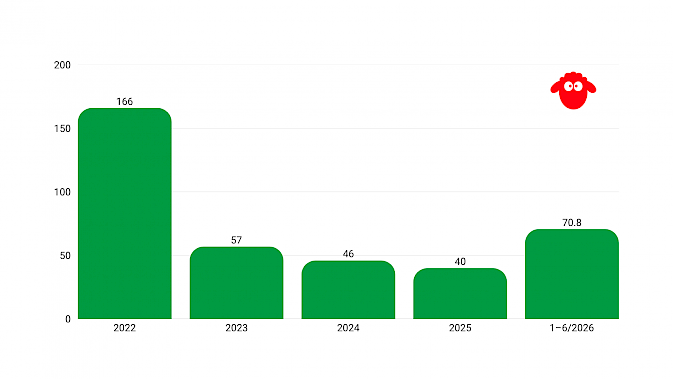 In 2025, the average wholesale electricity price was around one quarter of the level seen during the energy crisis in 2022. However, the first half of 2026 shows that price volatility remains a feature of the electricity market. Source: Finnish Energy / Nord Pool.